You’ve probably heard people throwing around terms like “QMS” and “ISO 9001” in manufacturing circles. Maybe your biggest client just asked if you’re ISO certified. Or perhaps you’re trying to figure out why your competitors seem to have fewer quality issues than you do.
So What is a quality management system exactly? And more importantly, why should you care?
Let’s break this down in plain language. No corporate jargon, no consultant-speak – just practical information you can actually use.
Understanding What Is a Quality Management System
At its core, What is a quality management system? Think of it as the playbook for how your organization ensures consistent quality. It’s the collection of processes, procedures, responsibilities, and resources you need to deliver products that meet customer requirements every single time.
But here’s what most definitions miss: QMS quality management systems aren’t just about catching bad products. They’re about building quality into everything you do, from how you train workers to how you select suppliers to how you handle customer feedback.
A proper QMS touches every corner of your business. It’s not something your quality department does while everyone else focuses on production. When implemented correctly, it becomes the framework that guides daily decisions across your entire operation.
The ISO 9001 Standard: The Global Benchmark
When people ask What is a quality management system, they’re usually really asking about ISO 9001. This international standard defines the requirements for QMS quality management systems that work.
ISO 9001 was first published back in 1987, and it’s been updated several times since – most recently in 2015. Why does this matter? Because ISO 9001 represents decades of accumulated knowledge about what actually works in quality management across thousands of companies in every industry imaginable.
Here’s the thing about ISO 9001: it’s not prescriptive about HOW you do things. It doesn’t tell you exactly what procedures to write or what forms to use. Instead, it sets requirements for what your system needs to accomplish, then lets you figure out the best way to do that for your specific situation.
This flexibility is brilliant. A textile manufacturer in Bangladesh and a leather goods producer in the UK can both be ISO 9001 certified, but their actual QMS implementation will look completely different because they’re solving different problems.
Why ISO 9001 Certification Matters
Getting your QMS quality management systems certified to ISO 9001 does several important things:
It proves to customers you’re serious about quality. Anyone can claim they have quality controls. Certification means an independent auditor verified that your system actually meets international standards.
It opens doors to new markets. Many large buyers – especially in Europe and North America – require ISO 9001 certification from their suppliers. Without it, you don’t even get considered for contracts.
It creates a foundation for improvement. The certification process forces you to document how things actually work, which makes it much easier to spot inefficiencies and fix problems.
It levels up your entire operation. Going through ISO implementation usually reveals gaps you didn’t know existed. Closing those gaps makes you more competitive.
The 7 Quality Management Principles Explained
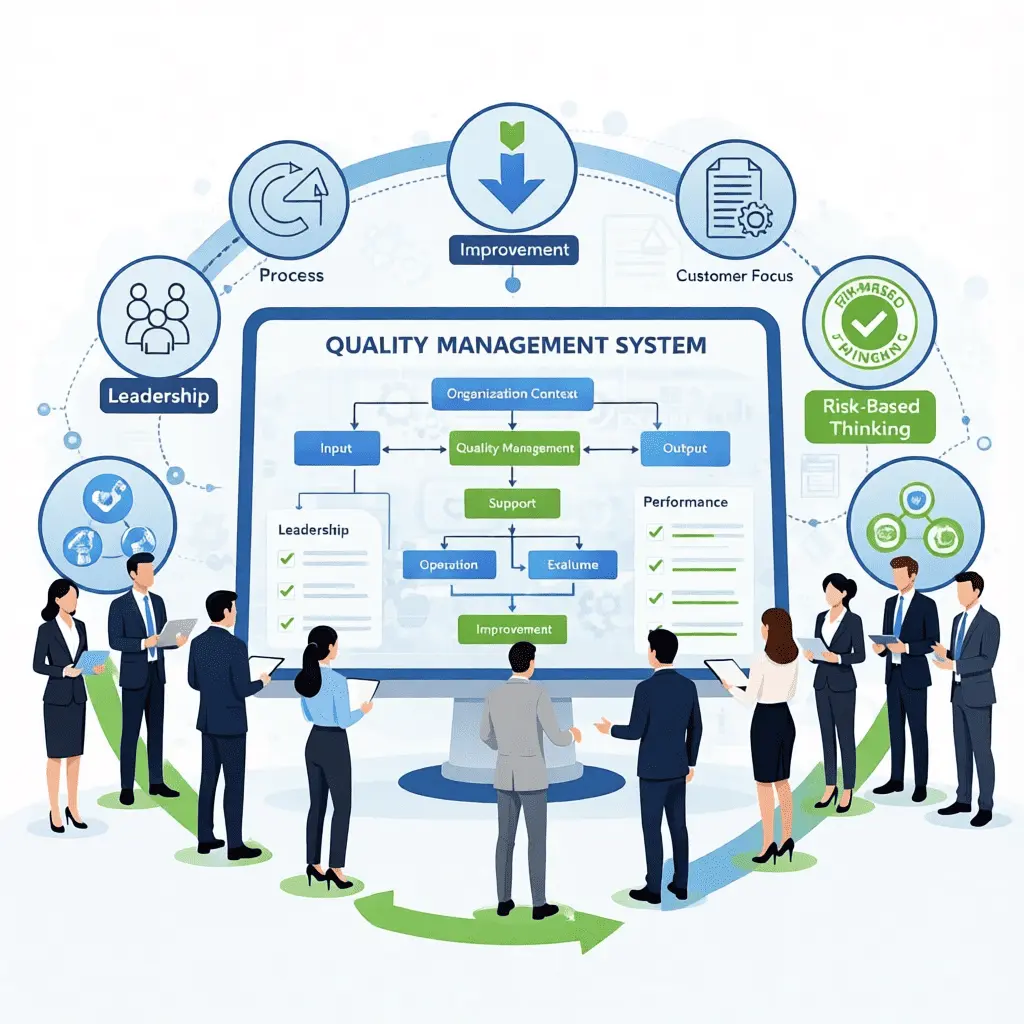
Now let’s dig into the real meat: the seven principles that form the foundation of ISO 9001 and modern QMS quality management systems. Understanding What is a quality management system means understanding these principles.
Principle 1: Customer Focus
Your primary focus should be meeting customer requirements and striving to exceed customer expectations. Sounds obvious, right? But you’d be surprised how many manufacturers lose sight of this.
Here’s what customer focus actually looks like in practice:
- You actively seek to understand current and future customer needs
- You align your organizational objectives with customer needs
- You measure customer satisfaction and act on the results
- You manage customer relationships to sustain success
In the textile and garment industry, customer focus might mean understanding that your buyer needs consistent color matching across production runs, or that delivery timing matters as much as product quality because their retail seasons are fixed.
Companies like Orange Bureau International help manufacturers maintain customer focus by providing third-party inspection that verifies whether products actually meet customer specifications. Their inspectors in Pakistan, Bangladesh, India, and the UK check whether your knitwear, woven garments, denim products, or sports goods actually match what customers ordered – not just what you think you produced.
Principle 2: Leadership
Quality needs commitment from the top. Leaders at all levels establish unity of purpose and create conditions where people are engaged in achieving quality objectives.
Leadership in QMS quality management systems means:
- Establishing a quality policy and quality objectives that align with your strategic direction
- Integrating quality requirements into all business processes
- Ensuring resources needed for the QMS are available
- Communicating the importance of effective quality management
- Making sure the QMS achieves its intended results
- Engaging, directing, and supporting people to contribute to QMS effectiveness
I’ve seen factories where management talks about quality but doesn’t actually support it with resources or decisions. Workers notice this disconnect immediately. They’ll stop caring about quality too if leadership doesn’t walk the talk.
Real leadership means sometimes stopping production to fix quality issues, even when you’re behind schedule. It means investing in training and proper equipment. It means listening when third-party inspectors like Orange Bureau International identify problems instead of shooting the messenger.
Principle 3: Engagement of People
Competent, empowered, and engaged people at all levels are essential to enhance the organization’s capability to create and deliver value.
This principle recognizes a simple truth: your QMS only works if people actually use it. And people only use systems they understand and believe in.
Engagement means:
- Ensuring people understand how they contribute to quality objectives
- Encouraging people to share knowledge and experience
- Recognizing and acknowledging people’s contributions
- Making quality everyone’s responsibility, not just the quality department’s job
- Enabling people to continuously improve their capabilities
When workers on your production floor understand why certain specifications matter – not just what they are – quality improves dramatically. Someone stitching garments should know that stitch density affects how the garment wears and washes, not just that “the standard says 12-14 stitches per inch.”
Principle 4: Process Approach
Consistent and predictable results are achieved more effectively when activities are understood and managed as interrelated processes that function as a coherent system.
This is where understanding What is a quality management system really clicks. Your organization isn’t a collection of random activities – it’s a system of interconnected processes.
The process approach means:
- Defining objectives for system processes and the resources needed
- Establishing responsibilities and authorities for managing processes
- Understanding your organization’s capabilities and determining resource constraints
- Identifying process interdependencies and analyzing their effects on individual processes
- Managing processes and their interrelationships as a system
- Ensuring information availability to operate and improve processes
- Managing risks that can affect process outputs and overall outcomes
Let’s make this concrete. In garment manufacturing, your processes might include: raw material procurement → incoming inspection → cutting → sewing → finishing → final inspection → packing → shipping. Each step affects the next. A problem in cutting creates problems in sewing. Poor incoming inspection means defective materials get built into finished products.
QMS quality management systems map these processes, define how they interact, and establish controls at critical points. Third-party inspection from services like Orange Bureau International typically focuses on key verification points in your process – incoming materials, in-process checks, and final inspection – to catch issues before they cascade through your system.
Principle 5: Improvement
Successful organizations have an ongoing focus on improvement. Improvement is essential to maintain current performance, react to changes in internal and external conditions, and create new opportunities.
This principle transforms What is a quality management system from a static set of procedures into a living, evolving framework for getting better.
Improvement activities include:
- Promoting establishment of improvement objectives at all levels
- Educating and training people at all levels on how to apply basic tools and methodologies to achieve improvement objectives
- Ensuring people are competent to successfully promote and complete improvement projects
- Developing and deploying processes to implement improvement projects throughout the organization
- Tracking, reviewing, and auditing the planning, implementation, completion, and results of improvement projects
- Integrating improvement considerations into development of new or modified products, services, and processes
Here’s where many manufacturers get it wrong: they think QMS quality management systems are about maintaining current quality levels. Actually, a proper QMS drives continuous improvement. Your defect rate this quarter should be lower than last quarter. Your customer complaints this year should be fewer than last year.
Data from inspections becomes gold for improvement. When Orange Bureau International inspects your home textile products or leather goods and identifies patterns in defects, that information should feed directly into improvement initiatives. Are most defects concentrated in one product type? One production line? One shift? This data tells you exactly where to focus improvement efforts.
Principle 6: Evidence-Based Decision Making
Decisions based on analysis and evaluation of data and information are more likely to produce desired results.
Gut feeling has its place in business, but not in quality management. QMS quality management systems rely on data.
Evidence-based decision making involves:
- Determining, measuring, and monitoring key indicators to demonstrate your organization’s performance
- Making all data accessible to relevant people
- Ensuring data and information are sufficiently accurate, reliable, and secure
- Analyzing and evaluating data and information using appropriate methods
- Ensuring people are competent to analyze and evaluate data as needed
- Making decisions and taking actions based on evidence, balanced with experience and intuition
This is why proper inspection and documentation matter so much. Without data, you can’t make informed decisions about quality.
Professional third-party inspection bodies like Orange Bureau International provide objective, documented evidence about your product quality. Their inspection reports aren’t opinions – they’re measurable data about whether products meet defined specifications. This evidence allows you to make smart decisions about process changes, supplier selection, training needs, and resource allocation.
Principle 7: Relationship Management
For sustained success, organizations manage their relationships with interested parties, such as suppliers and partners.
No manufacturer operates in isolation. Your quality depends heavily on your suppliers’ quality. Your success depends on your customers’ success. QMS quality management systems recognize these interdependencies.
Relationship management includes:
- Identifying interested parties and their relationship with your organization
- Establishing relationships that balance short-term gains with long-term considerations
- Pooling expertise and resources with partners
- Sharing information and future plans with relevant interested parties
- Establishing collaborative development and improvement activities
- Inspiring, encouraging, and recognizing improvements and achievements
In practical terms, this means developing your suppliers’ capabilities alongside your own. Share your quality standards. Provide feedback on material quality. Work together to solve recurring problems.
It also means building long-term customer relationships. When buyers see you’re committed to systematic quality management – evidenced by ISO 9001 certification and professional third-party inspection – they view you as a partner rather than just a vendor.
Orange Bureau International facilitates these relationships by providing independent verification that both manufacturers and buyers trust. Their inspection services create common ground and shared understanding of quality standards, which strengthens business relationships.
How QMS Quality Management Systems Work in Practice
So we’ve covered What is a quality management system theoretically. Now let’s talk about how QMS quality management systems actually function day-to-day in manufacturing environments like textiles, garments, sports goods, and leather products.
Documentation and Procedures
Your QMS needs documented information that defines:
- Your quality policy and quality objectives
- Scope of your QMS
- Processes needed for your QMS and their interactions
- Procedures required by ISO 9001
- Documents needed to ensure effective process operation and control
- Records that prove conformity to requirements
This doesn’t mean drowning in paperwork. Modern QMS quality management systems use digital documentation that’s accessible where people need it, when they need it.
Planning and Objectives
You establish quality objectives at relevant functions, levels, and processes. These objectives need to be:
- Consistent with your quality policy
- Measurable
- Taking into account applicable requirements
- Relevant to product and service conformity
- Monitored and updated as appropriate
For example, a knitted garment manufacturer might set objectives like: “Reduce stitching defects by 20% over the next six months” or “Achieve 95% first-pass inspection acceptance rate on fabric incoming inspection.”
Resource Management
QMS quality management systems require you to determine and provide resources needed, including:
- People with necessary competence
- Buildings, equipment, and infrastructure
- Environment suitable for operation of processes
- Monitoring and measuring resources
- Organizational knowledge
This is where investment comes in. You might need better cutting equipment. Additional training for sewing operators. Climate control for fabric storage. Professional inspection services from companies like Orange Bureau International to supplement your internal capabilities.
Operational Planning and Control
You plan, implement, and control processes needed to meet product and service requirements by:
- Determining requirements for products and services
- Establishing criteria for processes and product acceptance
- Determining resources needed
- Implementing process control according to criteria
- Determining, maintaining, and retaining documented information to demonstrate conformity
In garment manufacturing, this might include specifications for each product, work instructions for sewing operations, inspection criteria at various stages, and records showing each batch was inspected and met requirements.
Performance Evaluation
You monitor, measure, analyze, and evaluate your QMS through:
- Determining what needs monitoring and measurement
- Determining methods for monitoring, measurement, analysis, and evaluation
- Determining when monitoring and measuring shall be performed
- Determining when results shall be analyzed and evaluated
- Evaluating the performance and effectiveness of your QMS
This is where inspection data becomes crucial. Third-party inspection from Orange Bureau International provides objective measurements of your product quality across different product categories – whether that’s denim products, home textiles, sports goods, camping equipment, or leather footwear. This data feeds into your performance evaluation and helps identify improvement opportunities.
Internal Audits
ISO 9001 requires periodic internal audits of your QMS to verify it:
- Conforms to your own requirements and ISO 9001 requirements
- Is effectively implemented and maintained
Internal audits are essentially your system checking itself. Are people following procedures? Are the procedures actually effective? Where are the gaps?
Management Review
Top management must review your QMS at planned intervals to ensure its continuing suitability, adequacy, effectiveness, and alignment with strategic direction.
Management reviews look at the big picture: Are we meeting quality objectives? What do customer satisfaction metrics show? What did audits reveal? Are we improving? What changes do we need?
Benefits of Implementing QMS Quality Management Systems
Understanding What is a quality management system is one thing. Understanding why you should implement one is equally important.
Reduced Costs
Poor quality costs money in waste, rework, returns, and lost customers. QMS quality management systems reduce these costs by preventing defects rather than catching them after the fact.
When Orange Bureau International inspectors catch quality issues during production rather than after shipping, you avoid the massive costs of customer complaints, returns, and brand damage.
Improved Efficiency
Documenting processes reveals inefficiencies. You might discover steps that add no value, redundant quality checks, or bottlenecks that slow production.
The process approach also helps you optimize workflow. When you understand how processes interact, you can improve transitions between steps and eliminate delays.
Better Customer Satisfaction
Consistent quality creates satisfied customers. Meeting delivery commitments creates satisfied customers. Responding quickly to issues creates satisfied customers.
QMS quality management systems help you do all three systematically rather than depending on heroic individual efforts.
Enhanced Reputation
ISO 9001 certification signals to the market that you’re a professional operation. It differentiates you from competitors who lack systematic quality management.
This reputation advantage opens doors to larger customers and premium markets that require demonstrated quality capabilities.
Increased Employee Engagement
Clear processes and procedures reduce confusion and stress. People know what’s expected and how their work contributes to overall quality.
When you involve employees in improvement activities, engagement increases. People want to work for organizations that value quality and continuous improvement.
Risk Reduction
QMS quality management systems include risk-based thinking throughout. You identify what could go wrong and take action to prevent problems.
This proactive approach reduces surprises – the production crisis that shuts down your line, the material shortage that delays shipments, the quality issue that costs you a major customer.
Implementing a QMS in Textile and Garment Manufacturing
Let’s get specific about implementing QMS quality management systems in industries like textiles, garments, sports goods, and leather products.
Start with Gap Analysis
Before you can answer What is a quality management system that works for YOUR organization, you need to understand where you currently stand.
Conduct a gap analysis comparing your current practices to ISO 9001 requirements. Where do you already meet requirements? Where are the gaps?
Many manufacturers discover they’re doing more than they think – they just haven’t documented it systematically. Others find gaps they didn’t know existed.
Define Your Scope
Your QMS scope defines what’s covered. For a garment manufacturer, this might be “Design, production, and delivery of knitted garments, woven garments, and denim products for export markets.”
Be realistic about scope. You can always expand it later as your system matures.
Document Key Processes
Map your major processes from customer order to product delivery. For each process, define:
- Inputs and outputs
- Process steps
- Responsibilities
- Controls and measurements
- Records generated
Don’t overcomplicate this. Start with major processes, then add detail where needed.
Establish Quality Objectives
Set measurable quality objectives aligned with business goals. Make them specific and time-bound.
Examples for textile manufacturing:
- “Reduce fabric shade variation defects by 30% within 12 months”
- “Achieve 98% on-time delivery rate by end of fiscal year”
- “Decrease customer complaints by 25% over next two quarters”
Implement Inspection Controls
This is where professional third-party inspection services become valuable. Orange Bureau International can help you implement inspection controls at critical points:
Incoming Inspection: Verify raw materials and components meet specifications before they enter production. This prevents defective inputs from becoming defective outputs.
In-Process Inspection: Check quality during production to catch issues early. For garments, this might include checking cutting accuracy, first-piece approval for sewing, and midline inspections.
Final Inspection: Comprehensive check before packing to ensure finished products meet all requirements. Orange Bureau International‘s trained inspectors can verify workmanship, measurements, packaging, and labeling across all product categories from home textiles to footwear.
Provide Training
Everyone needs to understand their role in your QMS. Training should cover:
- Quality policy and objectives
- How their work affects quality
- Specific quality requirements for their tasks
- Procedures they’re responsible for
- How to identify and report quality issues
Training isn’t one-and-done. Regular refreshers keep quality top of mind.
Monitor and Measure
Implement the measurements you defined. Track defect rates, customer complaints, on-time delivery, inspection results, and other key indicators.
Regular inspection reports from third-party services provide valuable trend data. If Orange Bureau International identifies recurring defects in your denim products or camping equipment, that pattern tells you where to focus improvement efforts.
Conduct Internal Audits
Schedule regular internal audits to verify your QMS is working as intended. Train internal auditors or bring in external help initially.
Audits should check both conformance (are we following our procedures?) and effectiveness (are our procedures actually working?).
Review and Improve
Hold management reviews to evaluate system performance. Use the data you’ve collected to make informed decisions about where to improve.
QMS quality management systems aren’t static. They evolve as your business evolves, as customer requirements change, and as you identify improvement opportunities.
The Role of Third-Party Inspection in Your QMS
Professional inspection services like Orange Bureau International play a crucial supporting role in effective QMS quality management systems.
Objective Verification
Internal inspectors, no matter how well-trained, can develop blind spots. Third-party inspectors bring fresh eyes and objective assessment.
When Orange Bureau International inspects your woven garments or leather products, they’re checking against defined specifications without any bias to pass marginal products to meet production targets.
Specialized Expertise
Third-party inspection bodies employ specialists trained in specific product categories. Someone who inspects sports goods daily knows exactly what to look for. A denim specialist understands unique quality issues in denim production.
This specialized knowledge catches issues that generalists might miss.
Customer Confidence
Many international buyers require third-party inspection as a condition of purchase. Independent verification from globally recognized bodies like Orange Bureau International provides assurance that products meet specifications.
This verification builds trust and strengthens business relationships.
Data for Improvement
Professional inspection services provide detailed reports that feed into your performance evaluation and improvement processes.
Over time, this data reveals patterns. Maybe quality dips during certain shifts. Perhaps one supplier consistently delivers better materials than another. Maybe specific product types have higher defect rates.
This information, properly analyzed, drives targeted improvements that strengthen your entire QMS.
Gap Identification
Third-party inspectors often identify gaps in your quality system during their inspections. Maybe your specifications are unclear on certain points. Perhaps certain inspection points are missing from your internal processes.
This feedback helps you strengthen your QMS quality management systems continuously.
Common Challenges When Implementing QMS Quality Management Systems
Let’s be realistic about challenges you’ll face. Knowing What is a quality management system intellectually is different from successfully implementing one.
Resistance to Change
People comfortable with current ways of working often resist new procedures and documentation requirements. They see the QMS as bureaucracy that slows them down.
Solution: Involve people in QMS development. When workers help create procedures, they’re more likely to follow them. Clearly communicate benefits – how the QMS makes their work easier and protects them from blame when problems occur.
Documentation Burden
Creating all the required documentation feels overwhelming, especially for smaller manufacturers without dedicated quality departments.
Solution: Start simple. Document what you actually do first, then refine. Use templates and examples. Consider bringing in consultants for initial setup. Remember that documentation doesn’t have to mean thick procedure manuals – simple work instructions and checklists often work better.
Resource Constraints
Implementing QMS quality management systems requires time, money, and people – resources that always feel scarce.
Solution: View it as investment rather than cost. Calculate what poor quality currently costs you in waste, rework, and lost customers. The QMS investment typically pays for itself quickly. Start small if needed – implement in one product line or one department, demonstrate success, then expand.
Maintaining Momentum
Initial enthusiasm fades. After certification, there’s temptation to let the system slide.
Solution: Integrate the QMS into daily operations rather than treating it as a separate quality department responsibility. Make quality metrics visible. Celebrate improvements. Keep management engaged through regular reviews.
Keeping Up With Changes
Your business changes. Customers requirements evolve. ISO standards update. Keeping your QMS current requires ongoing effort.
Solution: Build review and update processes into your system from the start. Assign clear responsibility for keeping documentation current. Use your management reviews to identify needed changes.
QMS Success Stories Across Different Product Categories
Understanding What is a quality management system becomes clearer when you see real examples of how QMS quality management systems transform businesses.
Knitwear Manufacturer in Bangladesh
A mid-sized knitwear producer was losing contracts to competitors despite competitive pricing. Customer complaints about sizing inconsistencies and color variations were increasing.
After implementing ISO 9001 and partnering with Orange Bureau International for regular third-party inspection, they identified that their cutting process lacked proper controls and their fabric storage conditions were causing quality variations.
Within eight months of implementing corrective actions: customer complaints dropped 60%, their first-pass inspection rate improved from 82% to 96%, and they secured two major European customers who required ISO certification.
Denim Products Manufacturer in Pakistan
A denim manufacturer struggled with wash consistency issues. The same style in the same wash program would come out slightly different from batch to batch, creating customer dissatisfaction.
Their QMS implementation focused on process controls for washing and finishing. They standardized chemical mixing, implemented wash bath temperature monitoring, and established visual standards for each wash effect.
Third-party inspection from Orange Bureau International helped verify wash consistency met customer standards before shipping. Within a year, wash-related complaints dropped by 85%, and they expanded into new markets requiring stricter quality standards.
Sports Goods Producer in India
A sports goods manufacturer producing footballs, cricket equipment, and camping gear wanted to expand into international markets but lacked the quality credentials buyers demanded.
ISO 9001 implementation forced them to systematize testing protocols – ensuring footballs met pressure retention standards, tents passed waterproofing tests, and cricket bats met safety requirements.
Professional inspection services verified compliance before shipment. The combination of ISO certification and third-party inspection reports opened doors to buyers in Europe and North America who previously wouldn’t consider them.
Home Textiles Exporter in UK
A UK-based home textiles company sourcing from multiple manufacturers struggled with inconsistent quality from different suppliers.
They implemented supplier quality requirements based on their own ISO 9001 QMS. All suppliers had to meet defined standards verified through Orange Bureau International inspections at source.
This approach reduced their incoming rejection rate from 18% to under 3%, dramatically reduced quality complaints from their retail customers, and actually lowered costs despite adding inspection services because they eliminated expensive returns and expedited shipping to replace defective shipments.
Your Quality Management System Roadmap
So you understand what is a quality management system and you’re convinced you need one. What’s the roadmap from where you are to ISO 9001 certification?
Months 1-2: Foundation
- Secure management commitment and resources
- Conduct gap analysis against ISO 9001
- Define QMS scope
- Establish project team
- Develop implementation timeline
Months 3-4: Documentation
- Draft quality policy and objectives
- Map major processes
- Create process documentation
- Develop required procedures
- Begin training on QMS concepts
Months 5-6: Implementation
- Roll out documented procedures
- Implement inspection controls (consider starting third-party inspection with services like Orange Bureau International )
- Begin collecting quality data and metrics
- Continue training throughout organization
- Make adjustments based on early feedback
Months 7-8: Internal Verification
- Conduct internal audits
- Hold first management review
- Identify and correct nonconformities
- Refine processes and documentation based on audit findings
- Ensure measurement and monitoring systems are functioning
Months 9-10: Pre-Certification Preparation
- Address all identified gaps
- Conduct final internal audit
- Hold management review
- Verify all documentation is current and accessible
- Ensure all personnel understand their QMS responsibilities
Months 11-12: Certification
- Select certification body
- Schedule and complete certification audit
- Address any audit findings
- Achieve certification
- Plan post-certification improvement initiatives
This timeline assumes moderate complexity. Simpler operations might move faster; larger, more complex manufacturers might need longer.
Maintaining Your QMS After Certification
Getting certified answers what is a quality management system in practice for your organization. But certification isn’t the finish line – it’s the starting line for ongoing improvement.
Surveillance Audits
Certification bodies conduct periodic surveillance audits (typically annually) to verify your QMS remains effective. Treat these as opportunities to demonstrate improvement, not just to prove you’re maintaining compliance.
Continual Improvement Focus
Use the data your QMS generates to drive ongoing improvements. Your defect rates this year should be lower than last year. Your process efficiency should keep improving.
System Evolution
As your business grows or changes, your QMS should evolve too. Adding new product lines? Expand your QMS scope. Entering new markets? Update your system to address their specific requirements.
People Development
Invest in growing your team’s quality management capabilities. Send key people for training. Develop internal auditors. Build quality expertise throughout your organization.
Partnership Strengthening
Deepen relationships with your inspection partners. Orange Bureau International and similar services aren’t just vendors – they’re partners in your quality journey. Their insights can help you improve faster.
Final Thoughts: Making Quality Management Work for You
We’ve covered a lot of ground exploring what is a quality management system, the seven principles underlying QMS quality management systems, and how to implement ISO 9001 in manufacturing environments.
Here’s what it boils down to: quality management isn’t about bureaucracy or paperwork. It’s about building systems that consistently deliver what customers want while continuously getting better at what you do.
The seven principles – customer focus, leadership, engagement of people, process approach, improvement, evidence-based decision making, and relationship management – aren’t abstract concepts. They’re practical guidance for building manufacturing excellence.
ISO 9001 provides the framework. Third-party inspection from professional services like Orange Bureau International provides objective verification. But the real work happens in your factory every day as your team applies these principles to produce quality products.
Whether you’re manufacturing knitted garments in Bangladesh, denim products in Pakistan, sports goods in India, or leather footwear in the UK, the fundamentals of quality management remain the same. Understand customer requirements. Design processes that consistently meet those requirements. Measure your performance. Fix problems. Keep improving.
That’s What is a quality management system at its heart – a systematic approach to consistently delivering quality while building the capability to get better over time.
The manufacturers who embrace this mindset, who invest in proper QMS quality management systems, and who partner with professional inspection services to verify their quality – those are the ones who thrive in increasingly competitive global markets.