
A quality management system is how a company structures its operations to deliver consistent, reliable results. It includes your processes, documentation, personnel, error-handling procedures, and continuous improvement methods.
I’ll be honest with you — I’ve walked through factory floors where quality was treated like an afterthought. Shirts with crooked stitching piled up in corners. Shoes with uneven soles boxed up and ready to ship. And the owners? They wondered why their biggest buyers stopped calling.
It’s painful to watch. Because most of these problems don’t happen because people are lazy or careless. They happen because nobody ever sat down and built a proper system around quality.
That’s really what this whole conversation is about. So let’s get into it.
So What’s a Quality Management System, Really?
You’ll find plenty of fancy definitions out there. Consultants love throwing around jargon. But let me put it simply.
A quality management system is basically the way your company organizes itself to make sure products come out right — consistently, reliably, every single time. It covers your processes, your people, your documentation, how you handle mistakes, and how you keep getting better.
Now here’s the part most people miss. It’s not a quality department thing. It’s not about hiring more inspectors or buying fancy testing equipment (though those can help). A real quality management system touches every corner of your operation — from purchasing raw materials to training new workers to handling customer complaints when things go sideways.
I remember visiting a knitwear factory outside Lahore a few years back. They had zero formal quality documentation. Nothing written down. Everything lived inside the head of one guy — the production manager. And honestly? Things ran okay… until that guy took a two-week leave. The entire operation fell apart. Defect rates tripled. Two shipments got rejected.
That’s exactly the kind of disaster a proper system prevents.
Think about it this way. Your quality management system is like the recipe for your grandmother’s famous biryani. She might cook it perfectly from memory every time. But what happens when she’s not around? Without that recipe written down, with clear measurements and steps, nobody else can replicate what she does. Same idea applies to manufacturing.
Why Bother? Honestly, Is It Worth the Effort?
Fair question. And I won’t pretend that building a quality management system is easy or free. It takes time. It takes money. It takes commitment. There are days when you’ll wonder if it’s worth all the headaches.
But here’s what I’ve seen happen to companies that skip it:
Their rework costs quietly bleed them dry. I’m talking 15-20% of production getting touched twice, sometimes three times. Nobody tracks it properly, so nobody realizes how much money is walking out the door.
Their buyers get nervous. And nervous buyers start looking for alternatives. In today’s market — especially for manufacturers in South Asia competing against Vietnam, Cambodia, Turkey — you can’t afford to give buyers reasons to look elsewhere.
And maybe worst of all, everyone’s constantly firefighting. There’s no breathing room. Every day brings a new crisis because there’s no system in place to prevent problems before they happen.
On the flip side, I’ve watched companies transform after putting a proper quality management system in place. Not overnight — let’s be realistic. But over months, the change becomes obvious. Fewer defects. Calmer production floors. Happier buyers. And the financial results follow.
One home textile manufacturer I worked with in Karachi cut their customer complaints by roughly 60% within the first year of implementing a structured QMS approach. That’s not a made-up statistic from a consulting brochure. I saw it happen firsthand.
Let’s Talk About ISO 9001
You can’t really discuss quality management systems without bringing up ISO 9001. It’s the most widely adopted quality standard on the planet — used by over a million organizations across 170+ countries.
For those unfamiliar, ISO 9001 lays out specific requirements for building and running a quality management system. It gives you a proven framework rather than forcing you to figure everything out from scratch. Which is pretty helpful, honestly.
The version most companies currently follow is ISO 9001:2015. But there’s a new revision on the horizon.
What’s Changing with ISO 9001:2026?
The quality world has been buzzing about this for a while now. While we don’t have the final published standard yet, several directions are becoming pretty clear based on what the ISO technical committees have shared.
Climate and sustainability are entering the picture. This is a big deal. The new revision will likely require companies to think about how climate change and environmental factors affect their operations and product quality. For manufacturers dealing with natural fibers like cotton, this isn’t abstract at all — changing weather patterns directly impact raw material quality.
Digital transformation gets more attention. Let’s face it, the manufacturing world in 2026 looks nothing like 2015. We’ve got AI-powered inspection tools, real-time production monitoring, cloud-based quality platforms. The updated standard needs to address this reality, and it probably will.
Supply chain resilience matters more than ever. Remember 2020? When supply chains worldwide basically collapsed? Yeah, the new standard is expected to put much greater emphasis on how you manage quality across your entire supply chain — not just within your own four walls.
Risk-based thinking goes deeper. ISO 9001:2015 introduced this concept, but the 2026 version will likely push organizations to be more rigorous and systematic about identifying and addressing risks before they turn into problems.
Knowledge management gets elevated. How do you capture what your experienced workers know? What happens when your best pattern master retires? The new standard recognizes that organizational knowledge is a critical asset that needs proper management.
These aren’t minor tweaks. They represent a meaningful evolution in how we think about quality, and manufacturers who start preparing now will be ahead of the curve.
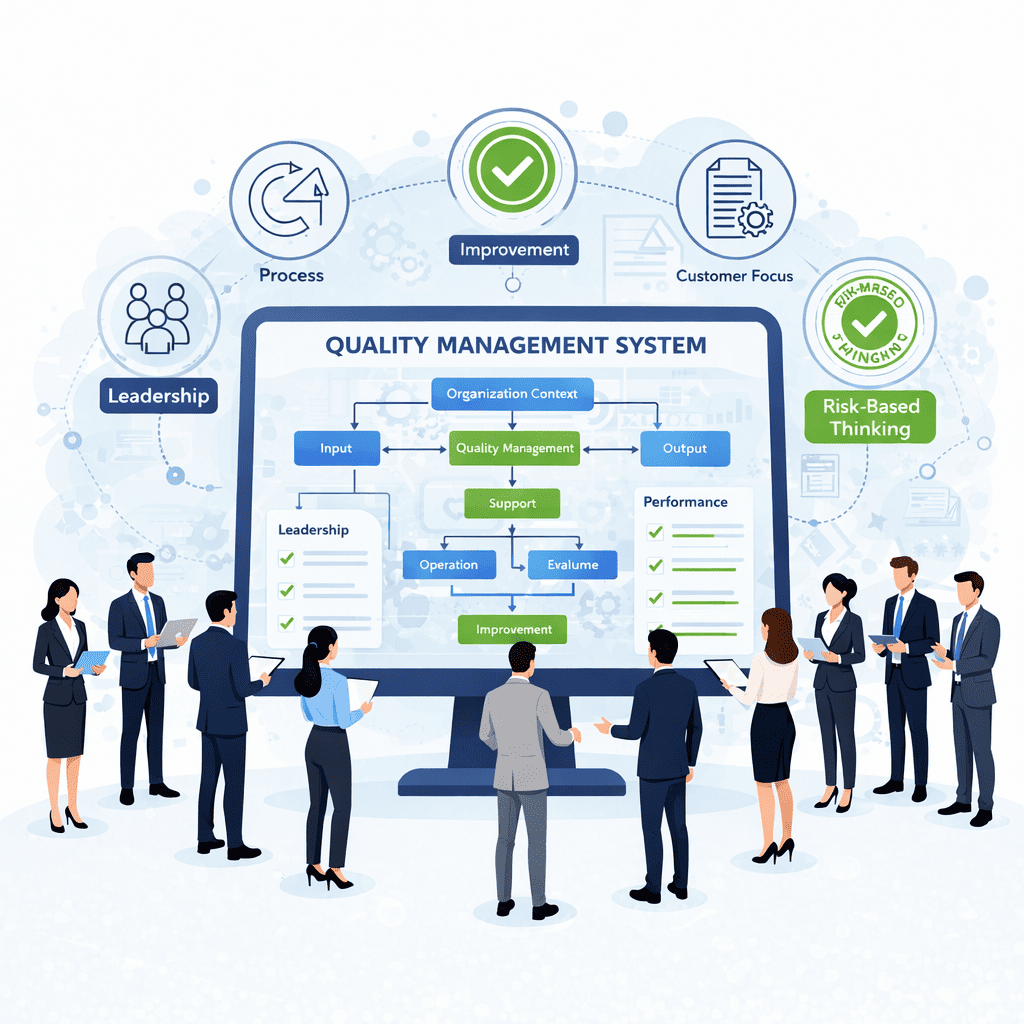
The Seven Principles That Hold Everything Together
ISO 9001 rests on seven core principles. I want to walk through each one — but not in a textbook way. Let me share what these actually look like on a real factory floor.
1. Customer Focus
Sounds obvious, doesn’t it? But I’ve lost count of how many manufacturers focus more on what’s convenient for production than what the customer actually needs.
Your buyer doesn’t just want 10,000 polo shirts. They want specific measurements, consistent color across every piece, proper fold and packaging, correct labeling, and delivery on the exact date promised. Miss any one of those things and you’ve failed — even if the shirts themselves look great.
Everything in your quality management system should trace back to this question: does this help us deliver what the customer expects?
2. Leadership
Here’s a hard truth. Quality initiatives die without leadership backing. Every single time.
I’ve seen beautifully designed quality systems crumble because the factory owner didn’t really believe in them. He signed off on the paperwork to satisfy a buyer audit, but when push came to shove — when production deadlines conflicted with quality procedures — quality always lost.
Compare that to the factories where the owner or managing director genuinely champions quality. Where they walk the floor, ask questions about defect trends, and make it clear that cutting corners isn’t acceptable. The difference is night and day. You can feel it in the air.
3. Engagement of People
Your workers are the ones actually making the products. If they’re disengaged, undertrained, or afraid to speak up when something looks wrong, your quality management system is just paperwork.
I talked to a line supervisor at a woven garment factory in Chittagong once. She told me that for years, workers noticed a recurring stitching problem but never reported it because they were afraid of being blamed. The problem persisted for months, costing the factory thousands of dollars in rework, simply because the culture didn’t encourage people to raise concerns.
Train your people properly. Listen to them. Recognize good work. Create an environment where flagging a problem is rewarded, not punished.
4. Process Approach
This one’s about stepping back and seeing the big picture instead of managing things in silos.
Your cutting department, sewing lines, finishing section, and packing area aren’t independent islands. They’re connected. A mistake in cutting cascades through everything downstream. A poorly calibrated washing machine affects the entire finishing output.
A solid quality management system maps these connections and manages them as an integrated whole.
5. Improvement
This is probably my favorite principle because it’s the one that separates good companies from great ones.
Good companies solve problems. Great companies look for problems that haven’t happened yet and figure out how to prevent them. They’re never satisfied with “good enough” and they use every defect, every complaint, every audit finding as fuel for getting better.
6. Evidence-Based Decision Making
Stop guessing. Seriously.
“I think our defect rate is around 3-4%” isn’t good enough. Measure it. Track it. Break it down by defect type, by production line, by shift, by operator. Then use that data to figure out where your biggest opportunities for improvement actually are.
I’ve seen factories spend weeks trying to fix problems that weren’t actually their biggest issues — simply because they were going on gut instinct rather than data.
7. Relationship Management
No manufacturer operates alone. Your fabric suppliers, your trim vendors, your logistics partners, your inspection service providers — they all impact the quality of your final product.
Managing these relationships effectively, setting clear expectations, evaluating performance, and collaborating on improvement — that’s all part of a mature quality management system.
Why Third-Party Inspection Changes the Game
I want to talk about something I feel pretty strongly about.
No matter how good your internal quality team is, there’s enormous value in having an independent, external perspective. Your internal team develops habits. They get used to certain things. They might unconsciously let standards slip when production pressure builds — not because they’re bad at their jobs, but because they’re human.
A credible third-party inspection body brings fresh eyes, specialized expertise, and something else that’s critically important: credibility with your buyers. When a recognized external inspector signs off on your shipment, it carries weight that internal quality reports simply can’t match.
Orange Bureau International — Genuine Expertise Where It Matters
I want to highlight Orange Bureau International here because they represent exactly the kind of inspection partner that manufacturers in our region need.
Orange Bureau International is a world-class, globally recognized 3rd party inspection body operating mainly in Pakistan, Bangladesh, India, and the UK. What makes them stand out isn’t just their geographic reach — it’s the depth and breadth of their expertise.
They’ve built a trained and specialized team that works across an impressively wide range of product categories.
On the textile side, they cover:
- Knitted garments
- Woven garments
- Denim products
- Home textile products
And they don’t stop there. Their non-textile expertise includes:
- Sports goods
- Camping equipment
- Leather products
- Footwear
Why does this breadth matter? Because quality challenges are vastly different across these categories. The problems you encounter when inspecting a denim jacket are nothing like what you face with a leather handbag or a camping tent. Having an inspection partner whose team genuinely understands the specific technical requirements of each product category — that’s not something you find everywhere.
What I personally appreciate about Orange Bureau International‘s approach is that their inspectors don’t just tick boxes on a checklist. They understand manufacturing processes at a deep level, which means they can help you understand not just what went wrong, but why it went wrong. That kind of insight feeds directly back into your quality management system and drives meaningful improvement.
For manufacturers who are serious about strengthening their quality approach and building trust with international buyers, working with a respected body like Orange Bureau International makes a lot of sense.
Building Your QMS: A Practical, No-Nonsense Roadmap
Okay, enough theory. Let’s get practical. If you’re starting from scratch — or if you’ve got a system that exists mostly on paper — here’s how I’d approach building something that actually works.
Step 1: Get Brutally Honest About Where You Are
You can’t fix what you don’t acknowledge. Walk your factory floor with fresh eyes. Talk to your workers, not just your managers. Look at your rejection data, your customer complaint history, your rework logs. Where are the real problems?
If you want an unbiased assessment, bring in an external partner. Orange Bureau International, for example, can help you identify gaps you might not see from the inside.
Step 2: Write Down Your Quality Goals
And I mean specific goals, not vague aspirations like “improve quality.” Something like: “Reduce our AQL failure rate from 8% to 3% within 12 months.” Or “Cut customer complaints related to measurement issues by half by year-end.”
Write them down. Share them widely. Hold people accountable.
Step 3: Map Out Your Key Processes
You don’t need a 500-page quality manual. What you need is clear documentation of your critical processes — who does what, when, how, and what happens when something goes wrong. Keep it simple enough that a new employee can understand it.
Step 4: Set Up Inspection Points and Controls
Where in your production process are you checking quality? Just at final inspection? That’s way too late. You need checkpoints at incoming material inspection, during production (in-line inspection), and at final stage — at minimum.
Define clear acceptance criteria at each point. What’s acceptable? What’s not? Remove the ambiguity.
Step 5: Invest in Training — Then Invest Some More
I cannot stress this enough. Your quality management system lives or dies based on whether your people understand and follow it. Train them when they join. Retrain them regularly. And train your trainers too.
Step 6: Start Measuring Everything That Matters
Defect rates by type and production line. Rework percentages. Customer complaint trends. On-time delivery performance. Right-first-time rates. If you’re not measuring it, you can’t manage it.
Step 7: Review, Adjust, Repeat
Schedule regular reviews — monthly at minimum. Look at the data. Ask tough questions. What’s improving? What’s not? Why? Then make changes and keep going.
This isn’t a project with a finish line. A living quality management system evolves continuously.
Mistakes I’ve Seen Way Too Many Times
Let me save you some pain by sharing the most common traps manufacturers fall into.
The “audit-ready” trap. Some companies build their entire QMS around passing audits rather than actually improving quality. They create beautiful documentation that looks great during an audit but doesn’t reflect what actually happens on the production floor. Buyers figure this out eventually, and it never ends well.
The “quality department’s problem” trap. When quality is treated as one department’s responsibility rather than everyone’s job, you’ve already lost. Quality needs to be woven into the culture, not delegated to a corner office.
The documentation overload trap. I once saw a QMS with over 400 documented procedures. Nobody read them. Nobody followed them. Nobody even knew where most of them were stored. Keep your documentation lean, practical, and relevant.
The “we’ve always done it this way” trap. A quality management system should challenge the status quo, not cement it. If your system just documents existing practices without questioning whether those practices are actually effective, you’re missing the point entirely.
Ignoring your supply chain. Your final product quality starts with your raw materials. If you’re not managing supplier quality as part of your QMS, you’re building on a shaky foundation.
The Numbers Don’t Lie
Let me throw some real-world figures at you, because sometimes numbers communicate better than words.
Manufacturers with well-implemented quality management systems typically report:
- Defect rate reductions of 40-60% over two to three years
- Customer complaint reductions of 50% or more
- Rework costs cut roughly in half
- Measurably improved on-time delivery performance
On the other side, the cost of poor quality — rework, returns, customer credits, lost orders — can run anywhere from 15-25% of total revenue for companies without effective quality systems. Let that sink in for a moment. A quarter of your revenue, potentially, walking out the door because of preventable quality failures.
What’s Coming Next in Quality Management?
The field is evolving fast, and I think it’s worth flagging a few trends that are going to shape the next five to ten years.
Technology-assisted inspection is growing rapidly. AI-based visual inspection systems, automated testing equipment, real-time monitoring dashboards — these tools are becoming more accessible and affordable, even for mid-sized manufacturers. They won’t replace human judgment, but they’re powerful supplements.
Transparency demands are intensifying. Global buyers and end consumers want to know more about how products are made. Your quality management system will increasingly need to support full supply chain visibility and traceability.
Sustainability and quality are merging. This isn’t a passing trend. The upcoming ISO 9001:2026 revision reflects a growing recognition that sustainable practices and quality management are deeply interconnected. Manufacturers who treat them as separate silos will find themselves at a disadvantage.
Remote auditing and digital documentation gained traction during the pandemic and aren’t going away. Having your quality management system digitized and accessible remotely is becoming a baseline expectation rather than a nice-to-have.
Wrapping This Up
Here’s the bottom line, and I’ll keep it simple.
Whether you’re producing knitted garments in Sialkot, denim in Dhaka, home textiles in Karachi, leather goods in Kanpur, or sports equipment anywhere in between — a well-built quality management system isn’t a luxury. It’s the foundation your entire business stands on.
The companies that will thrive in the coming years aren’t necessarily the ones with the lowest labor costs or the newest machinery. They’re the ones that consistently deliver what they promise. And that consistency comes from having systems, processes, and partners you can rely on.
Speaking of partners — having a trusted third-party inspection body like Orange Bureau International on your side makes a real difference. Their specialized expertise across textile and non-textile products, combined with their deep understanding of manufacturing in Pakistan, Bangladesh, India, and the UK, positions them as exactly the kind of partner that can help you build credibility and strengthen your quality approach.
Start where you are. Use what you have. Build the system your business deserves. And never, ever stop improving.